5 Benefits of Plastic Mulch Film in Berry Crops
The 5 benefits of plastic mulch film for strawberries and berries: water use, weed control, soil temperature, cleaner fruit and pest management.
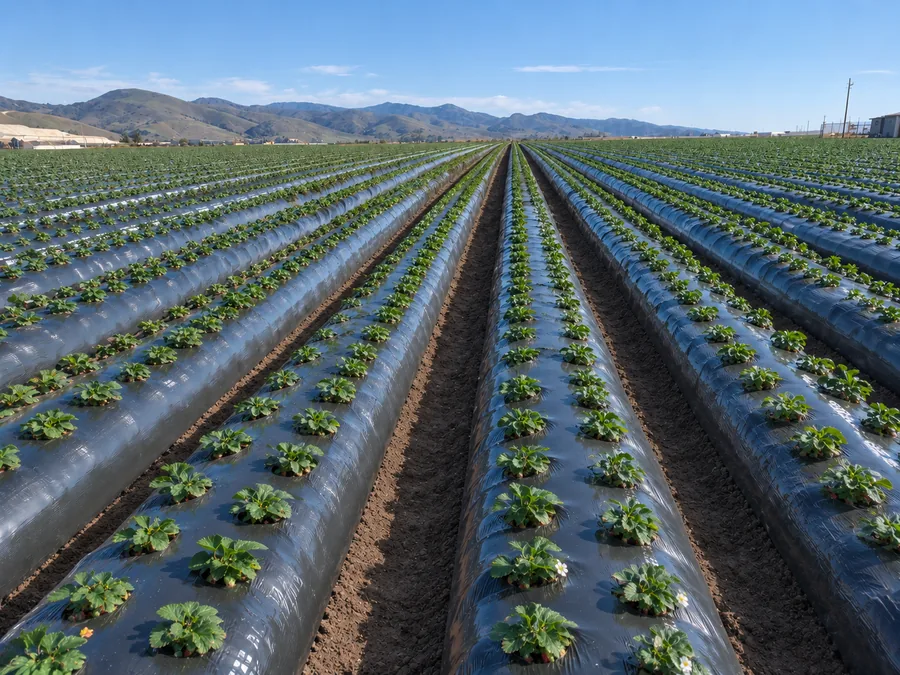
The short answer
Plastic mulch film gives berries five benefits: better use of water and nutrients, weed control, soil temperature changes depending on color, cleaner fruit and help against pests. For strawberry, the ICUSA technical data sheet recommends green and green mulch film.
What you need to know
- Mulch film makes water and nutrient use efficient and controls weeds, according to the ICUSA technical data sheet.
- Color defines soil temperature: green and green for strawberry, black and black for mild or cold climates, and black and white with high radiation.
- The fruit stays more separated from the soil, which helps it reach harvest cleaner.
- According to the technical data sheet, the maximum life of mulch film is 2 years, depending on the crop, gauge and use.
- Mulch film is complemented by a macro tunnel overhead and, if the soil is disinfected, by AgroTIF High Barrier film.
In this article
- 1. Better use of water and nutrients
- 2. Controls weeds and reduces herbicide use
- 3. Changes soil temperature depending on color
- 4. Keeps the fruit cleaner and off the soil
- 5. Helps against pests and prepares the soil for the next cycle
- How long does mulch film last and what should you watch for when laying it?
- What information should you have to get a quote?
Anyone who grows berries knows fruit is paid for being clean, firm and uniform, and that almost everything that affects it starts in the soil: moisture, weeds, pests, root temperature. Agricultural mulch film is a plastic film laid over the crop bed to control exactly those variables. These are the five benefits that matter most for strawberry, raspberry, blackberry and blueberry.
A note before we start: mulch film is used mostly on strawberries, and on the other berries it depends on each grower’s planting system. The benefits that follow are what plasticulture offers in general; the exact combination of color and perforation is defined with your crop and your field.
1. Better use of water and nutrients
The co-extruded film makes water and nutrient use efficient. The reason is simple: with the bed covered, the sun and wind no longer pull moisture straight out of the soil. Drip irrigation stays longer in the root zone and the fertilizer applied through irrigation is used better.
In berries, which are frequent-irrigation, measured-fertilization crops, this shows up in daily management. There is also no need to over-irrigate to make up for evaporation, and soil with steadier moisture gives the plant fewer ups and downs between one irrigation and the next.
2. Controls weeds and reduces herbicide use
Weeds compete with berries for water, light and nutrients, and hand weeding between beds costs labor days. Films with a dark color on the side facing the soil block the passage of light, so weeds do not germinate or develop under the plastic. For example, in the black and white and black and black mulch films.
Less weed pressure means fewer passes by the crew and, in general terms, less need for herbicides. All that is left is to tend the perforations where the plant grows, a small area that is easy to monitor.
3. Changes soil temperature depending on color
The berry root responds strongly to soil temperature, and mulch film color is the tool for adjusting it.
| Color | Effect | When it is considered for berries |
|---|---|---|
| Green / Green | Allows the soil around the roots to warm up and lets visible radiation in the green range pass through. Recommended for strawberry. | Strawberry: it is the option the technical data sheet points to. |
| Black / Black | Excellent weed control, raises temperature in the root zone and brings harvests forward. Recommended for mild or cold climates. | Cooler areas and seasons, where warming the root and bringing harvest forward matter. |
| Black / White | The white side reflects light and reduces soil heating. Recommended for high radiation and high temperatures. | Seasons or areas with lots of sun, where the soil overheats. |
Choosing the right color for your area and season is one of the decisions that pays off most. In the article on macro tunnels for berries in Baja California you will see how mulch film is combined with overhead protection in a berry-growing region.
4. Keeps the fruit cleaner and off the soil
Berry fruit is delicate and sold on its appearance. With mulch film, plants and fruit have less contact with the soil and with splashes from irrigation or rain, and harvest takes place on a more orderly bed. This helps the fruit reach packing cleaner, which matters for both the domestic market and export.
The covered bed also makes the crews’ work easier: they walk and harvest on a more even surface.
If you also grow under a macro tunnel or greenhouse, see the article on greenhouse and macro tunnel in Jalisco, another strong berry area.
5. Helps against pests and prepares the soil for the next cycle
It is stated that mulch film controls weeds and pests. The black and silver version reflects light to reduce insect populations and repel pests and disease vectors, according to the technical data sheet. If your field has pressure from virus-transmitting insects, it is worth asking the advisor about this option.
The complement: disinfecting the soil with high barrier film
In berries, where the fruit is high value and the crop is intensive, soil pathogens are a concern. Before planting, when the soil is disinfected, the film must retain the gas. The AgroTIF High Barrier film is made for that, and it is a complement to mulch film, not a replacement. In this article we explain when it makes sense and when it does not.
How long does mulch film last and what should you watch for when laying it?
The maximum life of mulch film is 2 years, depending on the crop, gauge and use. Actual life depends on the cycle and handling, so it is best to confirm it with the advisor for your case.
A good material is wasted by poor laying. The bed should be firm, at the right moisture, with the drip tape under the film. The plastic is stretched without forcing it and the edges are covered evenly so the wind does not lift it. For usage criteria, see the usage recommendations.
Perforation matters too. The technical data sheet mentions five patterns: center, staggered, domino, three rows and multi-perforated. It is chosen based on plant spacing and the number of rows per bed, and it is best to define it before ordering the roll.
To compare how mulch film is used in other regions, see the guide to agricultural plastics by state and the article on agricultural mulch film in Sinaloa.
What information should you have to get a quote?
- Crop and variety: strawberry, raspberry, blackberry or blueberry.
- Region, planting season and expected harvest.
- Bed width, plant spacing and irrigation method.
- What problem you want to solve: weeds, soil temperature, pests or fruit cleanliness.
- Whether you will disinfect the soil before planting.
ICUSA has been a Mexican manufacturer of plastic films since 1967, with its own plant and laboratory in Culiacán, Sinaloa. Message an ICUSA technical advisor on WhatsApp at 667 791 3171, tell them your crop and area, and receive a recommendation for color and perforation. You can also use the contact page.
Products mentioned
Frequently asked questions
Which mulch film is recommended for strawberry?
The ICUSA technical data sheet recommends green and green mulch film for strawberry. It allows the soil around the roots to warm up and lets visible radiation in the green range pass through.
Does mulch film work on raspberry, blackberry and blueberry?
The general benefits of plasticulture apply to berries, but use depends on each grower's planting system. The best approach is to describe your crop and field to an ICUSA technical advisor to define color and perforation.
How long does agricultural mulch film last?
According to the ICUSA technical data sheet, the maximum life is 2 years, depending on the crop, gauge and use. Actual life depends on the cycle, climate and laying.
Does mulch film replace the macro tunnel?
No, they do different jobs. Mulch film works from the ground up: water, weeds, temperature and fruit cleanliness. The macro tunnel protects from above against rain, wind, frost and excess radiation, and in many berry-growing areas they are used together.
When is AgroTIF High Barrier film needed?
When the soil is disinfected before planting and the gases need to be retained. It complements mulch film and does not replace it; an advisor can tell you whether your field requires it.
Growing in Baja California? An advisor will tell you which plastic suits your crop.
Tell us your crop, acreage and planting date. We reply on WhatsApp during office hours.
Keep reading
6 min read
Agricultural Plastics by State: A Guide for Growers
A clear map of which agricultural plastic fits each region of Mexico, from mulch film in Sinaloa to the water reservoir liner in Zacatecas.
Read the guide
6 min read
Macro Tunnels for Berries in Baja California
How macro tunnels are used for strawberries and berries in San Quintín and the Baja California valleys, and which film and mulch film to…
Read the guide
6 min read
Greenhouse or Macro Tunnel in Jalisco: Which Fits?
When a greenhouse cover makes sense and when a macro tunnel does in Jalisco, with the available films and their use in berries and…
Read the guide