Blue and Yellow Sticky Traps: Greenhouse and Field Use
Blue and yellow sticky traps help monitor and reduce insects. Here is what each color attracts or repels and how to place them.
The short answer
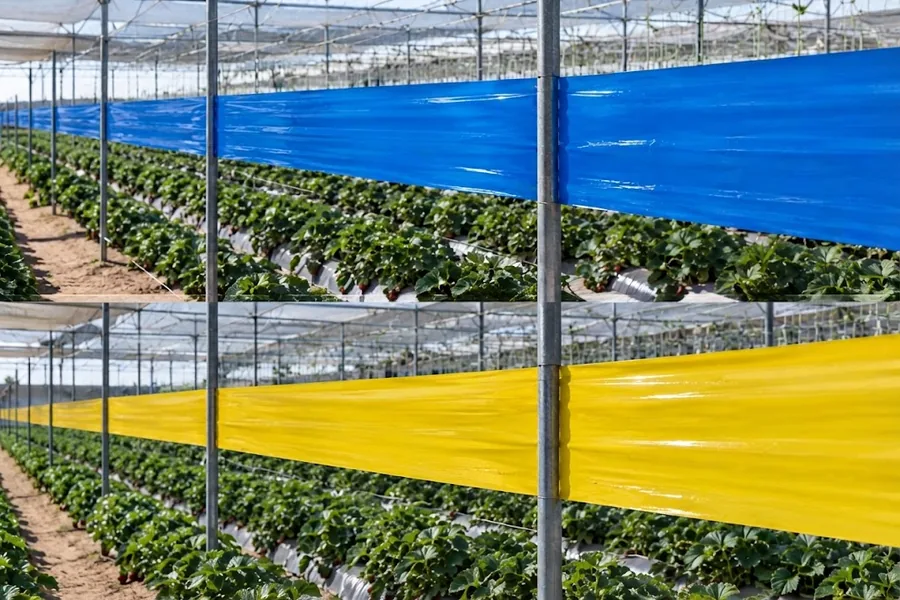
Color traps take advantage of color: according to ICUSA, yellow attracts insects such as whiteflies. Blue, on the other hand, repels insects of the aphid type. They are used to monitor infestation and reduce populations, in both greenhouses and open field. They work best when checked regularly.
What you need to know
- ICUSA sticky insect traps help reduce insect populations and monitor infestation levels.
- They come in blue or yellow, with the same color on both sides, for greenhouse and open-field use.
- According to ICUSA, yellow attracts insects such as whiteflies. Blue repels insects of the aphid type and is also commonly used to monitor thrips.
- The most useful practice is to check them at a fixed frequency and record the trend.
- They are a tool for integrated management, not a stand-alone control.
In this article
- What is a color trap and why does it work?
- Which insects does each color attract or repel?
- How are they used in a greenhouse?
- How are they used in open field?
- When does monitoring matter most?
- How many traps do I need and how often do I replace them?
- Are traps enough to control a pest?
- Where can you get them?
What is a color trap and why does it work?
Many pest insects orient by color. A color trap takes advantage of that behavior: a brightly colored surface attracts certain insects and holds them. Sticky insect traps help reduce insect populations and make it possible to monitor infestation levels in crop areas. Those are their two functions, and it is worth telling them apart: one is control and the other is surveillance.
The monitoring function is usually the most valuable. A trap that is checked regularly tells you the pest has arrived before it is visible on the plant, and that gives you time to decide on a response calmly. The ICUSA agricultural sticky insect trap is offered in blue or yellow, with the same color on both sides.
Which insects does each color attract or repel?
| Color | What ICUSA says | Pests that commonly concern growers |
|---|---|---|
| Yellow | Attracts insects such as whiteflies | Whitefly in tomato, chili pepper and cucumber; it also helps monitor other small flying insects |
| Blue | Repels insects of the aphid type | Aphids, and in field practice it is also used to monitor thrips |
The yellow color attracts insects such as whiteflies. Blue, on the other hand, repels insects of the aphid type. In the agronomic literature it is also common to use the blue trap to monitor thrips. Before buying for a specific pest, confirm with the advisor which color suits your crop, because the answer depends on the species you have.
How are they used in a greenhouse?
Inside a greenhouse the air is calmer and pests move less, so traps give a more faithful reading of what is happening. Some general practices:
- Hang them at foliage height or slightly above, and raise them as the crop grows.
- Place more traps near entrances, windows and areas where insects arrive, because that is where the pest shows up first.
- Check and record catches at a fixed frequency. What matters is the trend, not an isolated count.
- Combine them with a suitable cover. Among the greenhouse covers is the anti-virus film, which according to the ICUSA technical data sheet blocks a range of ultraviolet radiation that insects need for orientation.
In regions such as Jalisco, where berries and vegetables are grown under cover, trap monitoring helps decide when to intervene. To see how the protected structure is put together, see greenhouse and macro tunnel in Jalisco.
How are they used in open field?
In open field, wind, rain and dust change things. The sticky insect film is placed on stakes or posts, at crop height. Three points deserve attention:
- Placement along the edges. The pest enters the field from the border, so that is where it is detected first.
- Frequent replacement. Dust and large insects cover the surface and reduce its usefulness.
- Records by field. Note the date and the field so you can compare from one week to the next.
In Sinaloa, where whitefly and the viruses it transmits are a well-known concern in tomato, chili pepper and cucumber, early monitoring is part of crop management. If you also use mulch film in colors that reflect light, such as black/silver, the technical data sheet indicates that this color reflects light to reduce insect population dynamics and repel pests. See the details in agricultural mulch film in Sinaloa.
When does monitoring matter most?
It depends on the region. In Sinaloa, the fall and winter vegetable cycle starts in the middle of the hot season, which is when pressure from flying insects tends to be highest, so traps should be in place from transplanting, not once there is already damage. In Jalisco, where many fields are under cover almost year-round, monitoring is continuous and is stepped up when humidity and temperature rise inside the structure. In both cases the rule is the same: install before the pest appears and keep the record.
How many traps do I need and how often do I replace them?
There is no single number that works for every case. The quantity depends on the area, the crop, the pest pressure and whether the trap is used only for monitoring or also to reduce the population. In general, monitoring needs fewer traps than mass trapping, and replacement is done when the surface is saturated with insects, dust or dirt. The advisor or your field agronomist can define the right density for your property.
Are traps enough to control a pest?
No. A color trap is one tool within integrated management: field cleanliness, weed control, suitable covers and nets, constant monitoring and, if needed, other measures approved by your agronomist. Its great contribution is information: it tells you what is there, where and how much, and that keeps you from applying blindly. If catches rise from one week to the next, that is the signal to inspect the field and talk to your agronomist. If they stay low, you can space out interventions with more confidence.
Where can you get them?
The sticky insect trap can be quoted with an advisor, along with the rest of your plastics order. To compare regions, see the guide to agricultural plastics by state. If you are in Jalisco or Sinaloa, ICUSA serves you directly from its plant in Culiacán: write to us from the contact page.
Products mentioned
Frequently asked questions
Which insects does the yellow trap attract?
According to ICUSA, the yellow color attracts insects such as whiteflies. That is why it is widely used in tomato, chili pepper and cucumber, in both greenhouse and open field, to monitor their presence.
What is the blue trap for?
According to ICUSA, blue repels insects of the aphid type. In field practice it is also used to monitor thrips. Confirm with an advisor which color suits the pest you have.
Can they be used in open field or only in greenhouses?
They can be used in both. The ICUSA catalog states they are used inside greenhouses and in open field. Outdoors they need to be replaced more often because of dust and wind.
Do the traps control the pest or just monitor it?
Both. They help reduce insect populations and make it possible to monitor infestation levels. But they do not replace integrated pest management, they only complement it.
How many traps should I put per hectare?
There is no single number. It depends on the crop, the pest pressure and whether you want to monitor or trap. An advisor or your field agronomist can define the right density for your property.
How often should I check and replace the traps?
The recommendation is to check them at a fixed frequency and record the catches. Replace them when the surface is full of insects, dust or dirt and no longer traps well.
Growing in Jalisco? An advisor will tell you which plastic suits your crop.
Tell us your crop, acreage and planting date. We reply on WhatsApp during office hours.
Keep reading
6 min read
Agricultural Plastics by State: A Guide for Growers
A clear map of which agricultural plastic fits each region of Mexico, from mulch film in Sinaloa to the water reservoir liner in Zacatecas.
Read the guide
6 min read
Greenhouse or Macro Tunnel in Jalisco: Which Fits?
When a greenhouse cover makes sense and when a macro tunnel does in Jalisco, with the available films and their use in berries and…
Read the guide
6 min read
AgroTIF Film: What It Is and When to Use It on Soil
AgroTIF is a high barrier film that retains soil disinfection gases. Here is when it makes sense and how it differs from solarization.
Read the guide